

The Datacenter Witchcraft Trials
Fear, rumor, opportunism, and the politics of technological hysteria

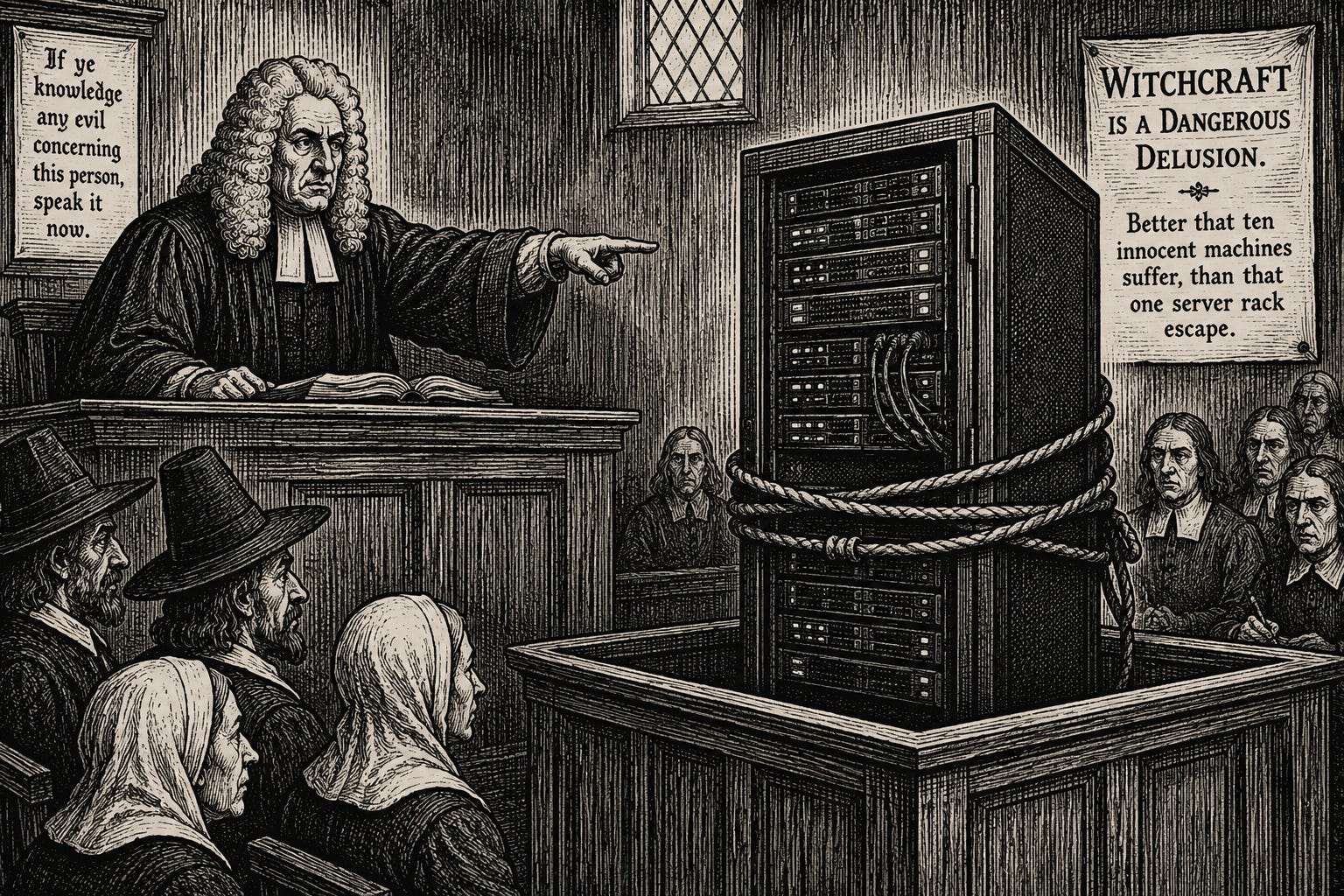
In 1692, in Salem, Massachusetts, a frightened population became convinced that invisible and poorly understood forces were operating within their community.
Rumor spread faster than evidence.
Suspicion became social currency.
Accusation became power.
Fear became self-reinforcing.
And before long, nearly everyone involved believed they were acting rationally.
That is the uncomfortable thing about hysteria:
the people inside it rarely recognize it as hysteria.
Now, before somebody loses their mind in the comments, let me be clear:
This does not mean all concerns about AI data centers are irrational.
Some are entirely legitimate.
The problem is that we are increasingly watching legitimate concerns become fused with fear, rumor, online amplification, political opportunism, and generalized technological anxiety into something far larger than the underlying engineering questions themselves.
And once that happens, facts alone stop mattering very much.
The Invisible Machine
Most people do not understand how modern AI infrastructure works.
That is not an insult.
Most people also do not understand:
electrical grids,
cloud architecture,
thermal management systems,
semiconductor fabrication,
or utility-scale infrastructure planning.
Nor should they be expected to.
But human beings are pattern-recognition creatures. When confronted with systems they do not understand, especially systems associated with rapid social change, they tend to fill informational voids with narrative.
That is where hysteria begins.
You can see the process unfolding already:
“They’re going to drain the aquifers.”
“They’re going to collapse the grid.”
“These things are environmental catastrophes.”
“This is all a scam.”
“AI is coming for your children/jobs/community/humanity.”
Some concerns are grounded.
Some are exaggerated.
Some are outright nonsense.
But once the emotional ecosystem forms, all claims begin reinforcing one another regardless of validity.
That is the danger.
The Kernel of Truth
Every hysteria requires a kernel of truth.
Salem had social tensions, religious rigidity, frontier insecurity, and genuine fear.
Modern datacenter backlash also contains legitimate issues.
AI infrastructure does consume enormous amounts of electricity.
Traditional cooling systems can require significant water usage.
Poorly planned facilities can generate noise, light pollution, and infrastructure strain.
These are real concerns.
But notice what often happens next.
The public discussion immediately shifts from:
“How do we mitigate these problems?”
to
“These facilities should not exist.”
That leap matters.
Because most of these concerns are engineering and governance problems, not apocalyptic impossibilities.
There are alternatives:
closed-loop cooling systems,
immersion cooling,
advanced thermal systems,
acoustic mitigation,
subterranean or partially subterranean construction,
shielded lighting,
dedicated generation,
and advanced nuclear concepts including small modular and pebble-bed reactor designs.
None of these solutions are free.
But they exist.
Which means the real argument is often not:
“Can this be done responsibly?”
but rather:
“Who pays the cost of doing it responsibly?”
That is a very different conversation.
Where the Hysteria Actually Comes From
Here is where things become politically dangerous.
Many municipalities and developers are handling these projects with the subtlety of a burglary crew.
Rushed zoning changes.
Opaque negotiations.
Sweetheart tax arrangements.
Environmental reviews conducted at warp speed.
Public meetings designed more to satisfy legal requirements than foster genuine participation.
In other words:
a legitimacy failure.
And once legitimacy begins to fracture, people stop trusting reassurances.
At that point, every rumor becomes believable because the population has already concluded:
“These people are hiding things from us.”
That is the exact ecosystem where hysteria flourishes.
Not because people are stupid.
Because trust has eroded.
The Symbolic Object
This is the part many analysts miss.
The datacenter itself is becoming symbolic.
For many people, it no longer represents:
servers,
cooling systems,
or digital infrastructure.
It represents:
globalization,
automation,
elite power,
technological acceleration,
loss of local control,
economic displacement,
and the growing feeling that ordinary citizens are no longer participants in decisions reshaping their communities.
The visible object becomes the vessel into which broader anxieties are poured.
That is why purely technical explanations often fail to calm opposition.
The fight is no longer purely technical.
The Smarter Path
The answer is not blind acceleration.
Nor is it technologically illiterate panic.
The answer is negotiated legitimacy.
If communities are expected to absorb the burdens associated with AI infrastructure, then they should have:
transparency,
enforceable environmental standards,
independent monitoring,
realistic mitigation requirements,
infrastructure guarantees,
and meaningful participation in the process.
Yes, this increases development costs.
Good.
Industrial systems should absorb the true cost of their externalities rather than offloading them onto the public while privatizing the gains.
But there is another benefit to transparency:
it deprives hysteria of oxygen.
When people believe they are being dealt with honestly, fear loses much of its political power.
And that may ultimately be the real lesson here.
Salem was not fundamentally about witches.
It was about fear moving faster than trust.
The modern datacenter debate risks becoming the same thing.