

Whither NATO
The alliance is not collapsing. It is migrating east.

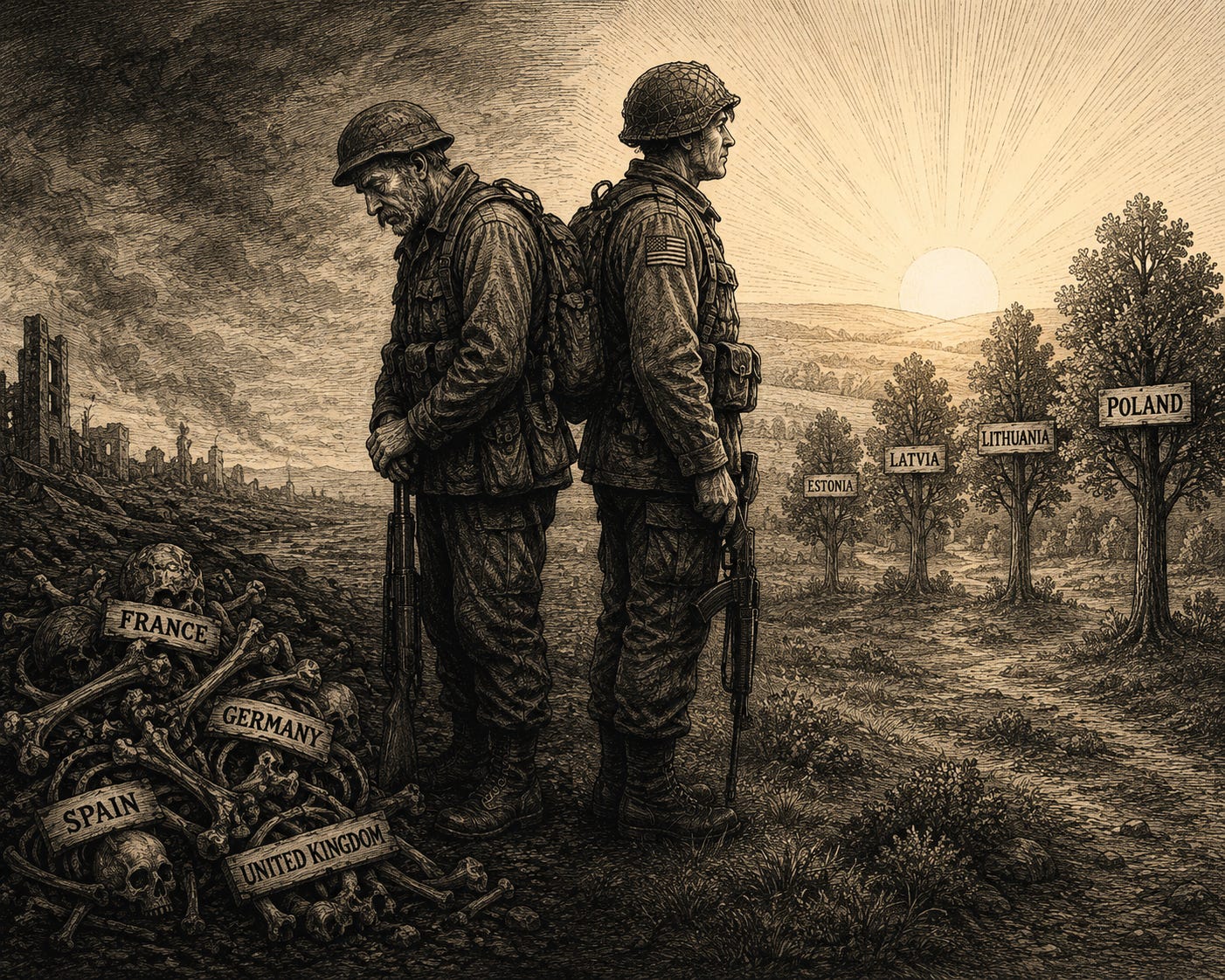
For most of the Cold War, the center of gravity inside NATO rested firmly in Western Europe.
France mattered.
Germany mattered.
Britain mattered.
The great question of European security revolved around whether Soviet armor would pour through the Fulda Gap while American forces rushed to reinforce the continent before the line broke.
The alliance structure reflected that reality.
The nations closest to Soviet power became the nations most committed to resisting it.
Fear sharpens alliances.
Shared danger clarifies priorities.
And for decades, Western Europe and the United States stood shoulder to shoulder because both understood the stakes in existential terms.
Then the Soviet Union collapsed.
And slowly, almost imperceptibly at first, NATO began changing.
Not institutionally.
Psychologically.
Once the immediate Soviet threat disappeared, much of Western Europe began reallocating its political and financial energy elsewhere.
Defense spending declined.
Welfare systems expanded.
Economic integration deepened.
The assumption settled over Europe that large-scale continental war had become improbable, perhaps even obsolete.
The United States, meanwhile, continued carrying enormous portions of the alliance’s hard-power burden.
American naval dominance protected trade routes.
American intelligence capabilities supported coalition security.
American logistics, strategic lift, nuclear deterrence, and expeditionary power remained the backbone beneath the structure.
Europe adapted to that arrangement because it could.
And because for a time, it worked.
But geography never stopped mattering.
History never stopped mattering.
Russia never stopped mattering.
The countries that remembered this most clearly were not always the great powers of Western Europe.
They were the states that had actually lived under Russian domination.
Poland.
Estonia.
Latvia.
Lithuania.
States whose historical memory of Moscow was not theoretical, academic, or distant.
It was personal.
And while portions of Western Europe increasingly viewed Russia through the lens of commerce and energy interdependence, Eastern Europe often continued viewing Russia through the lens of survival.
Ukraine changed everything because it validated many of those fears publicly.
The old NATO assumption set fractured almost overnight.
The countries once viewed as peripheral suddenly became central.
Not because NATO declared them central.
Because reality did.
Today, some of NATO’s most committed members are no longer necessarily the wealthiest or most politically influential nations in the alliance.
They are the nations closest to the threat.
That matters.
Because alliances are not held together by ceremony.
They are held together by aligned perception of danger.
And increasingly, Europe no longer shares a unified perception of danger.
France exercises realpolitik.
Germany exercises realpolitik.
Spain exercises realpolitik.
They pursue policies based on their own domestic pressures, economic priorities, energy needs, migration concerns, political coalitions, and strategic calculations.
That is not betrayal.
It is state behavior.
In many ways, Europe is simply returning to the strategic logic it historically practiced for centuries before the post-Cold War era temporarily obscured it.
The Europeans invented realpolitik.
Now they are exercising it again.
But so are Poland and the Baltic states.
Because their strategic reality is different.
For Warsaw, Tallinn, Riga, and Vilnius, Russia is not an abstract geopolitical issue discussed in think tanks.
It is a physical presence near their borders with a long historical memory attached to it.
And Russia itself is entering a dangerous phase.
Not necessarily because it is growing stronger.
Possibly because many of its structural pressures are intensifying simultaneously.
The Ukraine war has exposed severe strains inside the Russian system.
Economic pressure.
Energy constraints.
Military losses.
Industrial strain.
Dependence on Chinese markets.
Shrinking leverage over Europe’s energy architecture.
A Russia losing influence and revenue while still possessing enormous military capability may become less stable strategically, not more.
History is filled with examples of powers becoming more unpredictable as their relative position weakens.
Especially when national prestige and regime legitimacy become tied to external confrontation.
That is what makes the coming decade dangerous.
Not simply Russian strength.
But Russian pressure.
Which raises the larger question:
Whither NATO?
Where is it headed?
The answer may be uncomfortable for many observers.
The NATO that emerged after the Cold War may no longer fully correspond to Europe’s actual security realities.
That does not mean NATO disappears.
It means its center of gravity may continue shifting eastward.
Toward the nations that perceive the threat most directly.
Toward the nations investing heavily in military preparedness.
Toward the nations treating deterrence as immediate rather than theoretical.
In practical terms, the next decade may witness the emergence of a more hardened inner alliance inside NATO itself.
A coalition centered increasingly around:
Poland,
the Baltic states,
portions of Scandinavia,
possibly Romania,
and those nations still viewing territorial defense as an urgent requirement rather than a legacy concern.
Not because ideology demands it.
Because geography does.
Because proximity does.
Because reality does.
Alliances evolve much like living systems. The traits that ensure success in one environment may become liabilities in another. Post-Cold War Europe rewarded economic integration, reduced military spending, and the assumption of long-term stability. The emerging European security environment rewards something else entirely: resilience, territorial defense, military readiness, and the ability to perceive danger early. In evolutionary terms, influence inside NATO may increasingly flow toward the states best adapted to the new strategic environment rather than the old one.
NATO is not necessarily dying.
But it is evolving.
And alliances evolve the same way nations do:
Through pressure.
Through fear.
Through changing realities.
The map remains the same.
The psychology underneath it does not.